

Navigating Minnesota EVV Requirements in 2026
EVV requirements are evolving fast for home care agencies in Minnesota. As of January 1, providers are now required to complete their HHAeXchange (HHAX) enrollment in the state EVV aggregator and meet 50% compliance for all billed visits. But the rules won’t remain that way for long: on July 1, this compliance requirement will be increasing to 80%, making EVV non-negotiable for the grand majority of Medicaid-funded home care.
During these transitions, agencies will be subject to compliance audits that cover both their past visit data and current EVV usage. To meet these new benchmarks, plan for future updates, and protect revenue at every stage, here’s everything agencies need to know about Minnesota EVV.
Overview of Minnesota EVV Requirements
Though EVV is mandated at the federal level, EVV requirements by state can vary quite a bit. In Minnesota, in-home or community-based support with Activities of Daily Living (ADLs) or Instrumental Activities of Daily Living (IADLs) are required to use EVV reporting. Hospice services are the only exception to this rule.
Interventions like personal services, crisis respite, direct skilled nursing, physical therapy, respiratory therapy, and speech therapy all fall under the EVV umbrella. For a full list of applicable services and their associated billing codes, click here.
Minnesota caregivers must capture the same six EVV data points as all other states: the individual receiving the service (the client), the individual providing the service (the caregiver), the service(s) provided, the appointment location, the date, and the appointment start and end time.
Ultimately, the role of EVV is to minimize fraudulent or inaccurate Medicaid claims. When agencies send off a bill for an EVV-mandatory visit, DHS will now perform a post-payment review by comparing the claim against the data in the aggregator used by the state. For example, if you bill for 10 hours of care but the EVV system only shows 6 hours of verified visits, the state may reclaim the overpaid amount or deny future claims.
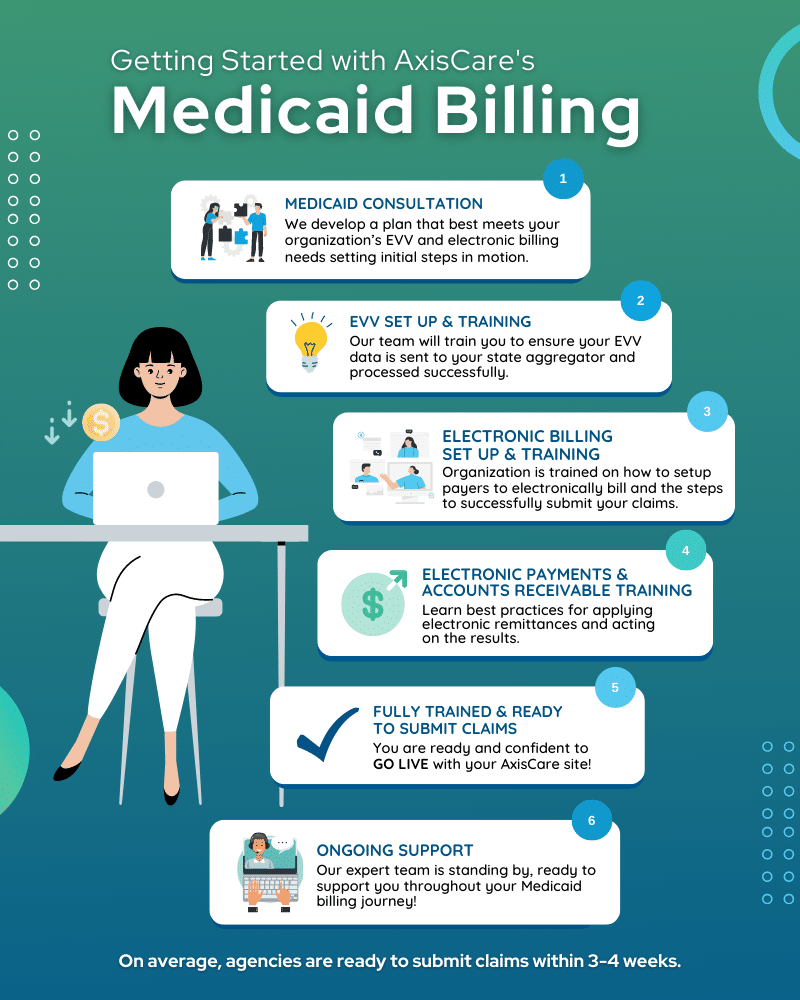
Although HHAX serves as Minnesota’s EVV aggregator, agencies are free to use a compliant software platform of their choice, such as AxisCare, as long as visit data flows into the state system. AxisCare’s dedicated Medicaid Billing team helps ensure customers remain compliant with EVV requirements while simplifying the billing process and reducing administrative burden.
Minnesota EVV in 2026: What’s New or Different
Minnesota first began implementing EVV on June 20, 2022. In the early days, the state’s primary goal was enrollment. Agencies were provided a grace period where they were not penalized for incomplete or incorrect EVV data, allowing them to work out technical issues without jeopardizing their cash flow.
As of September 1, 2024, state authorities began to monitor agencies’ EVV adherence more closely, though they still had a decent amount of flexibility. As long as agencies demonstrated a good-faith effort to respect compliance, they were unlikely to incur any penalties.
In 2026, that leniency no longer applies. Minnesota’s top priority is cracking down on compliance and ensuring the system is being used as intended; airtight EVV data is now a bare necessity with severe consequences for noncompliance. There are now specific percentage-based benchmarks in place, like the 50% compliance requirement that’s been in place since January 1.
How Minnesota EVV Interacts With Federal Requirements
Minnesota’s EVV program is built on top of a nationwide foundation. The 21st Century Cures Act serves as the primary mandate, requiring all states to implement an EVV system to remain eligible for full federal Medicaid funding. While federal regulations determine which data agencies must collect, it’s up to Minnesota’s Department of Human Services (DHS) to determine how these rules are enforced and integrated into billing cycles.
For example, Minnesota has adopted a hybrid model when it comes to choosing an EVV vendor. Agencies are free to use the state’s basic EVV system or a third-party vendor that meets basic compatibility requirements. No matter the vendor, all data must flow into the state’s aggregator to be considered valid. Minnesota DHS is also the entity that set forth the 50-80% compliance benchmarks being rolled out in 2026.
How EVV Data Affects Billing & Payment in Minnesota
The information captured during a home care visit has a long journey ahead of it. Once a GPS-enabled mobile app logs the “big six” data points, it sends the data from the provider’s software to the aggregator used by Minnesota DHS. The aggregator then verifies that the information satisfies compliance requirements.
Once the visit data is confirmed to be clean and compliant, it can be used by billing teams to create and submit a claim. Medicaid will compare the claim’s data against the information logged in the aggregator once it receives the agency’s bill, ensuring the number of hours invoiced and services delivered are using the correct codes.
If the claim and the EVV record match perfectly, the claim is approved for payment. If there is no matching EVV record found in the aggregator, or if the invoice contains an error, the claim may be flagged for manual review or rejected. Common issues include mismatched program codes, overlapping time logs, and hours that have been incorrectly rounded up or down.
Operational Risks of Poor EVV Compliance in 2026
Now that Minnesota is tightening the requirements for compliant claims, billing is higher-risk than ever before. Claims without a verified EVV match are being denied at the source, freezing portions of an agency’s revenue while they spend time and resources remediating incorrect information.
For most agencies, even a small margin of error can trap thousands of dollars in a rejection bottleneck. And as soon as cash flows become interrupted, it can quickly become difficult to meet payroll or cover overhead costs.
Given the multi-team chain that handles EVV data, there’s plenty of opportunity for user error to take hold. If caregivers don’t follow exact EVV protocols, admin teams will be forced into cleanup mode, chasing down missing clock-ins and manually correcting program codes. These same errors — double entry, missing information — can also crop up during back-office tasks.
By allocating precious resources to re-doing work that’s been completed incorrectly, agencies are effectively lowering their profit margins on every hour of care provided. In addition to claim denials and jammed-up cash flows, poorly implemented EVV creates a permanent trail of non-compliance that can catch auditors’ attention. And if the state wants to crack open an agency’s records, clawbacks and recoupments are usually not far behind.
Building Strong EVV Workflows in Minnesota
Approved claims begin with clean data collected on the front lines. For example, using a mobile app to establish standardized clock-in/clock-out routines for caregivers eliminates the need to enter data post-visit. This simple rule eliminates risk on two levels: manual entry is more prone to human error, and information logged after the fact may be misremembered.
Once data is captured via an app, it should be routed straight to a centralized EVV software system, creating a single source of truth for all stakeholders. From physicians to billing teams, everyone should be working from the exact same pool of information to eliminate double entry and create a seamless audit trail.
These platforms should also be able to flag missing or incorrect information before it makes it to the aggregator. By catching a no-show or failed GPS sync immediately, home care software enables admin teams to quickly resolve issues before they create a financial bottleneck.
Now that compliance benchmarks have come into play, EVV should be treated as a mission-critical KPI. Tracking and reporting must be fully integrated into administrators’ weekly routines to meet the state’s 80% mandate, keeping an eye on adherence at all times. As soon as compliance dips below acceptable levels, leaders must have a plan in place to address shortcomings and provide supplementary training to staff members that are failing to properly weave EVV into their workflows.
Integrating Minnesota EVV With Scheduling & Billing Systems
Fragmented systems allow data to slip through the cracks: every time administrators move information from a time tracking app into a separate billing tool, the risk of a typo looms large.
If scheduling tools don’t connect directly with EVV systems, any visit that isn’t logged properly will be “lost,” only to be discovered days or weeks later during billing reconciliation. By then, it will likely be too late to fix the data for a clean submission. And now that Minnesota requires every single character to match EVV records perfectly, a single-digit error can lead to an automatic denial.
Different digital platforms may also use different rounding logic. For example, if your EVV tool rounds a 53-minute visit differently than your billing software, the resulting claim will not match the aggregator record, triggering a review or rejection.
When these tools are unified and working from a single source of data, there’s no need for manual entry at any point; it’s a closed system that seamlessly feeds information from one function to another.
Choosing Technology That Fits Minnesota’s Requirements
With compliance enforcement at an all-time high, a simple GPS app won’t cut it for Minnesota home care agencies. Your chosen software should proactively prevent errors before they reach the state aggregator, protecting your revenue and taking the burden off administrators’ shoulders.
Since HHAX is the state’s aggregator, your vendor should also provide an API that connects directly to the system. It should also come pre-loaded with Minnesota’s HCPCS and modifier combinations, preventing caregivers from logging services they aren’t authorized to provide.
Airtight EVV records rely on real-time information capture, which can get tricky in rural or low-service areas. Make sure your chosen vendor’s mobile app is reliable in offline mode, automatically syncing GPS-verified data as soon as caregivers return to a service area. The system should also support clean data by sending push notifications to caregivers who forget to clock out or attempt to start an appointment at an incorrect location.
Live compliance dashboards will signal whether your agency is hitting the new 50-80% benchmark. In the event of noncompliance, the software should be flagging problematic visits so administrators know exactly which entries require attention. Whenever a manual change is made, the system should require a reason code that aligns with Minnesota DHS policy.
Of course, none of these features will be relevant if caregivers don’t adopt your new EVV system. Choosing a vendor that offers an intuitive interface is just as important as state-relevant compliance tools. Even the least tech-savvy employees should be able to navigate apps and dashboards with ease — if not, your compliance rates will suffer purely due to a lack of usership.
Remain EVV Compliant in Minnesota With AxisCare
It’s more important than ever for Minnesota home care agencies to stay on top of EVV compliance. Just like the rules have evolved in 2026, they will continue to change over time; agencies need a software partner that can grow alongside them, accommodating legislative updates with agility and ease.
With built-in EVV tools, direct integration with the aggregator, and support from the #1-rated home care software platform, AxisCare helps agencies maintain compliance while keeping operations running smoothly.
Request a free demo with our team to learn more about how we serve organizations that are local to Minnesota, and how we can support your compliance efforts at every step.