Key Takeaways:
- Onboarding is the starting line, not the finish line — the client-provider relationship only becomes valuable when supported by proactive, ongoing engagement after setup is complete.
- Effective customer success care hinges on three pillars: deep client segmentation, proactive communication, and technology that scales personalized support without increasing admin burden.
- High-touch and low-touch engagement models serve different client needs — assigning the right model based on care complexity and support needs is the key to efficient, effective retention.
- A structured customer journey map — with defined milestones, touchpoints, and messaging for each phase — gives agencies a repeatable system for delivering consistent care experiences at scale.
- SMART goals and KPIs (client retention rate, resolution lifecycle, care plan adherence) are essential for measuring whether a customer success program is actually working.
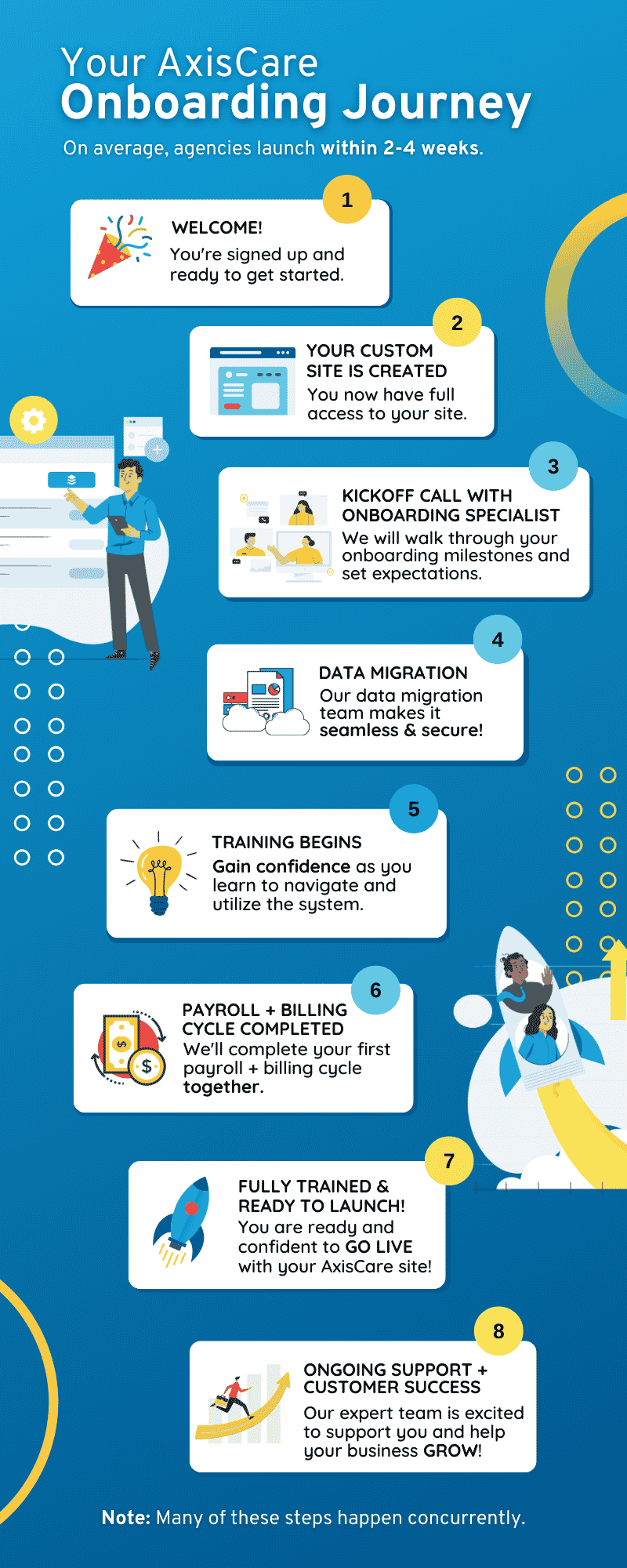
A robust onboarding program welcomes new clients into your digital universe – but it only tells half the story. The onboarding process is often misunderstood as the end of the sales journey, but what it really marks is the beginning of the client-provider relationship.
Businesses are coming around to the need for a more holistic approach to customer care. As recipients of Software Advice’s “Best Customer Support” badge for 2025, we wanted to shine a light on this fast-growing movement.
The Evolution of Customer Success Care
Customer success care has evolved beyond onboarding to encompass the full client lifecycle — emphasizing long-term engagement, proactive support, and personalized relationship management from initial setup through ongoing care. For home care agencies, this shift is especially critical given rising competition, caregiver turnover, and client retention pressures.
The customer success revolution hinges on the awareness that onboarding and customer attraction are worth very little if retention isn’t also part of the equation. It emphasizes long-term engagement, personalized support, and proactive relationship management that endures long after the initial setup, recognizing the entire customer journey as an opportunity to deliver value.
Home care has always been a competitive industry, and there are more factors working against agencies than ever before. The American population is aging, with demand for services rising as a result. Caregiver 90-day turnover is spiking, and employee retention is an uphill battle. Providers who want to survive and thrive in this environment will need to reevaluate their approach to onboarding and consider whether they’re providing enough long-term support to keep clients on the roster for the long haul.
The Limits of Onboarding Alone
Onboarding establishes trust and sets expectations — but it can’t sustain a client relationship on its own. Without ongoing follow-ups, proactive check-ins, and structured engagement throughout the client lifecycle, agencies risk losing clients to competitors who offer more attentive long-term support.
Onboarding might be the first time new clients interface directly with your agency’s team. It’s your chance to make an impression, establish trust, get customers acquainted with your service offering, and help them understand the value you can add to their lives. When done well, it’s the foundation of a lasting relationship – but that’s as far as it can take you.
A major driver behind AxisCare’s recent win is our dedication to delivering long-term customer support. Our team understands that onboarding is simply a jump-off point; we make sure to connect with clients via regular follow-ups and check-ins to deepen loyalty and satisfaction throughout the lifecycle. These proactive efforts create space for clients to share any issues they may have, helping to identify them early and resolve them even more quickly.
Key Pillars of Effective Customer Success
Effective customer success programs are built on three pillars: deep client understanding and segmentation to personalize care, proactive engagement and education to stay ahead of issues, and integrated technology to deliver that support consistently at scale.
Deep Customer Understanding & Segmentation
In a broad sense, your client base will seek out your services for the same handful of reasons – for home care, it might be assistance with daily activities, post-hospitalization rehab, or physical therapy, to name a few. However, a strong customer success care strategy will make time to understand clients individually, seeking to understand their unique goals and needs.
That information can then be used as a springboard for effective segmentation, enhancing your ability to provide more personalized care that improves health outcomes over time.
Proactive Engagement & Education
When it comes to customer success, proactiveness is the name of the game. Rather than waiting for issues to surface, keeping an open line of communication with clients is the key to identifying potential challenges early. Someone might be experiencing a change in mobility or a need to adjust their medication dosage; checking in frequently and making communication tools widely available will ensure important information is received in a timely manner.
By recognizing these early risk factors, providers can quickly adjust care plans and empower clients and families with the knowledge they need to make informed decisions. Education is an especially important pillar of the client-provider relationship, giving individuals the tools to actively participate in shaping their care journey. Whether it’s guidance on managing medications or lifestyle adjustment advice, education provides the building blocks for confidence.
Leveraging Technology & Automation
A customer relationship management (CRM) system is where all of the information mentioned above should live. CRM can centralize client data like care plans, preferences, health history, and communication logs, giving care teams the background they need to provide informed, responsive support.
Through automation, agencies can use digital platforms to perform routine check-ins. Using software is non-negotiable if you want to roll out an involved client care strategy at scale: at the click of a button, administrators can receive important reminders, schedule follow-ups, and share resources, providing personalized service without breaking a sweat.
Building a Customer Success Care Plan
A customer success care plan starts with SMART goals and measurable KPIs, followed by choosing the right engagement model (high-touch or low-touch) for each client segment, and a journey map that defines the milestones, touchpoints, and messaging for every phase of care.
A fruitful customer success journey starts with a strong roadmap. From square one to execution, here’s how to approach the transition.
Setting Goals & Defining Success
How will you know whether your efforts are paying off? You’ll decide what a successful program looks like from the very beginning. The good news is, there are many frameworks that already exist to help you iron out this step of the process.
When setting goals, stick to the SMART framework to formulate strong objectives: Specific, Measurable, Achievable, Relevant, and Time-bound. Once those goals are defined, outline some Key Performance Indicators – such as client retention rate, problem-to-resolution lifecycle, and care plan adherence – to measure your objectives’ performance.
Choosing the Right Engagement Model
High-touch and low-touch customer success models offer different levels of direct interaction and personalized client support.
A high-touch approach is excellent for building strong relationships and increasing satisfaction among clients with more complex care needs. It involves frequent personalized interactions like check-ins, at-home visits, and detailed care coordination. This level of involvement is particularly useful for individuals with chronic conditions or limited family support.
On the other hand, a low-touch model is better suited for clients who are in stable condition or have a stronger family support system. It still involves routine contact and follow-ups but relies more heavily on scalable tools like automated messaging and digital monitoring. With this model, agencies can allocate their resources more efficiently while casting a wide net without overwhelming their admin and care staff.
Choosing which model to apply traces back to segmentation, which we mentioned earlier. Organizing your client roster based on factors like care complexity, risk level, and engagement preference will help you assign the right strategies to the right individuals.
Mapping the Customer Journey
Follow-ups. Check-ins. Care plan updates. Agencies need to be methodical about when and how they communicate with clients, and it all starts with outlining key milestones, touchpoints, and messaging that align with each phase of the client journey.
Step 1: Onboarding
- Milestones: Intake completed, care plan developed, first caregiver visit
- Touchpoints: Welcome call or visit, care plan review session, first-week satisfaction check-in
- Messaging: Welcome email with key contacts and resources, what to expect during week one, caregiver introduction, and visit schedule
Step 2: The First Three Months
- Milestones: Client is settled with a regular caregiver, initial feedback collected, care plan reviewed for accuracy
- Touchpoints: Weekly or biweekly check-ins, 30-day satisfaction survey or call, first care plan adjustment if required
- Messaging: Tips for making the most of home care services, tailored educational materials needed (e.g., fall prevention, medication reminders)
Step 3: Ongoing Care and Relationship Management
- Milestones: Quarterly care plan updates, noticeable changes in health or routine, family feedback received
- Touchpoints: Monthly or quarterly check-ins, occasional wellness calls or visits, proactive alerts for health or schedule changes
- Messaging: Seasonal health tips and safety guides, invitations to agency events or webinars, reminders for medical reassessments
Move Beyond Onboarding for Real Results With AxisCare
AxisCare pairs award-winning home care software with a dedicated customer success team that stays engaged throughout your agency’s entire journey — from implementation and training to ongoing check-ins, care plan optimization, and long-term growth support.
We know a thing or two about customer success, and we’d love to show you how it’s done! Request a free demo to experience AxisCare’s award-winning support and learn how you can deliver the same to your client base.
FAQs
Customer success in home care is an ongoing approach to client engagement that extends well beyond initial onboarding. It involves proactive check-ins, personalized support, education, and relationship management throughout the entire client lifecycle — with the goal of improving retention, care outcomes, and long-term satisfaction.
A high-touch model involves frequent, personalized interactions — regular check-ins, at-home visits, and detailed care coordination — best suited for clients with complex needs or limited support systems. A low-touch model relies on automated messaging and periodic contact, making it more scalable for clients in stable condition with strong family support.
Key performance indicators for home care customer success programs typically include client retention rate, problem-to-resolution lifecycle, care plan adherence, satisfaction survey scores, and caregiver consistency rates. These metrics together show whether clients are engaged, well-served, and likely to stay with the agency long-term.
Onboarding is the starting point of a customer success strategy, not the end of it. It establishes the initial relationship and sets expectations — but sustained value comes from the follow-up touchpoints, proactive education, and personalized engagement that continue throughout the client journey after setup is complete.
Home care software with CRM capabilities centralizes client data, automates routine check-ins, and provides visibility into care plan adherence and engagement history. This allows agencies to scale personalized client support without adding significant admin workload — making a structured customer success program feasible even for large, multi-location agencies.