Key Takeaways
- Billing delays and denials are symptoms of a larger issue: disconnected home care systems
- Effective RCM integration requires clean data flow across client documentation, scheduling, and billing
- Before vetting vendors, agencies must understand their existing tech stack and define success metrics
- It’s essential for digital solutions to scale alongside your business, especially for enterprise use cases
- A home health audit is a formal review by Medicare, Medicaid, or a private payer that examines an agency’s claims, documentation, and billing practices. The goal is to verify that billed services were medically necessary, properly delivered, and accurately reimbursed.
Revenue cycle management (RCM) is the process of tracking and collecting payment for home health services, from the initial client visit through claims submission and receiving your funds.
It’s common for agencies to deal with multiple payers, each one with their own complex billing rules and documentation demands; RCM systems must therefore be fully integrated into an agency’s larger software ecosystem, placing the same set of up-to-date data at admin teams’ fingertips. When these systems operate in silos, admins may begin pulling information from different sources, leading to billing delays and claim denials.
Read on for best practices for protecting your cash flows, from understanding common RCM pitfalls to core requirements for your chosen home care software vendor.
Why RCM Integration Matters for Digital Health Platforms
RCM doesn’t pull data out of thin air: it’s fueled by information that’s been captured by and stored in other systems like scheduling, clinical documentation, and client intake information. If this data doesn’t flow directly into your RCM, admins will need to enter it manually, which immediately introduces the risk of duplicate or mistyped information. And the quickest path to a claim denial is a simple typo or omission.
Without an integrated home care platform, client visits get logged in one system, but billing teams use a different one. Documentation is incomplete or inconsistent because it wasn’t captured at the point of care in a standardized format. The list goes on and on, and the more disconnected your systems, the more difficult it is to catch errors before they become denials.
If a mistake does slip through, agencies must spend time and resources on correcting and resubmitting rejected claims. In the meantime, they’re left waiting far longer than anticipated for their reimbursement. Integrated RCM software unites all of these disparate systems, facilitating information transfer between departments, reducing the likelihood of an error, and therefore protecting cash flows.
Core RCM Integration Requirements for Digital Health Platforms
A strong RCM integration begins with free-flowing data in all directions. Clinical, scheduling, and billing systems must be able to communicate with each other seamlessly, relying on the same sources of information: an integrated system will pull point-of-care data and send it straight to your billing systems, generating clean claims that can be traced right back to pre-validated information.
Instead of periodic batch updates, real-time data syncing keeps each department in the loop from one minute to the next, avoiding discrepancies due to lag. Automatic claim scrubbing adds another layer of protection, catching errors before submission with no need for manual intervention.
None of this would be possible without accurate, trustworthy visit data as a primary source. Before caregivers can clock in for an appointment, they must verify a few basic details via Electronic Visit Verification (EVV), typically using a mobile app. Any notes logged during the appointment can be tied back to the client’s record and care plan — which are stored in the same central hub — to demonstrate medical necessity and support the associated claim.
Beyond medical necessity, clients must also maintain active eligibility status to continue receiving certain services. Integrated platforms run real-time eligibility verification before services are rendered, and send alerts to administrators when authorizations are expiring or visits are approaching their allotted limits.
Once a claim is sent off, dashboards help admins keep track of each one’s current status, as well as zoomed-out statistics like denial rates over time, days in accounts receivable, and average reimbursement timelines. These dashboards provide broad access to everyone involved in operations management, not just the billing department, rallying teams around shared goals and providing visibility into the agency’s overall health and productivity.
The entire data chain is supported by detailed, time-stamped audit trails, which provide essential backing during audits and compliance reviews.
Interoperability & Real-Time Data Exchange
Health systems communicate with each other using their own unique languages, namely HL7 and FHIR, to share data without custom workarounds. APIs can also be used to plug one system’s interface into another to create a smooth, single-platform experience for the user — for example, a caregiver clocking out of an appointment using EVV, triggering a billable event within the same system.
When systems share a common language, patient data can automatically flow from scheduling to billing, speeding up the claims submission process by eliminating the need for manual handoffs. What’s more, staff spend less time on double entry and data reconciliation.
Security, Compliance, & Data Accuracy
Any data shared between clinical, billing, and payer systems must follow HIPAA regulations, both while in transit (encryption is a must during this step) and once it’s been received. At all times, role-based access must be in place to ensure staff members can only handle data they’re authorized to view. Each time the data is accessed or modified, the action must be logged in an audit trail.
These steps are important not just for minimizing legal risk, but also to ease administrative burden. Knowing that compliance tools are built directly into your RCM system means staff aren’t the only ones checking for errors; the platform handles verification on its own, reducing the likelihood of errors that can damage operational and financial health.
Workflow Alignment & Billing Readiness
Data mapping is the process of “matching” fields like patient name, service codes, and payer IDs between different systems. For example, if visit notes don’t map to billable service codes, claims may be sent off with incorrect information or require manual intervention before submission. If a claim is denied due to improper mapping, the correction process can add weeks to the payment cycle while eating up administrators’ time.
Common Challenges When Integrating RCM Into Existing Systems
In a perfect world, RCM systems would slot cleanly into an agency’s existing tech infrastructure. But many organizations are using EHRs, billing software, and scheduling tools that were never designed to work together — making RCM simply another layer on top of an already crowded setup.
Legacy Systems & Fragmentation
Oftentimes, agencies rely on legacy tech that does not support API integration and therefore cannot enable bi-directional data flow. Instead, they must export data to locally saved documents, transfer files via email, or use third-party solutions, all of which create gaps for information to fall through the cracks.
Different systems may also use their own codes and field tags for the same information, making it impossible to map data automatically. Instead, administrators must perform the laborious task of checking data line-by-line. The same is true for different payers, who each have their own compliance requirements, portals, and data formats. Scalable, cloud-based architecture is the best way to enable interoperability, creating a hub where all of your data is standardized and connected.
Manual Workflows & Revenue Leakage
When systems are fractured, visit information doesn’t always make it to the billing team in one piece. Services are performed without the proper authorizations. Care plan changes aren’t shared team-wide. All of these issues lead to claim delays and errors, which inevitably harm the revenue cycle.
How To Evaluate RCM Integration Requirements
Data flow is the single most important consideration for RCM software. Can the platform communicate with your existing billing and clinical systems, sending information bi-directionally with ease? Does it support standard formats like FHIR, or does it require custom workarounds? Does data sync in real time organization-wide?
The right platform will be able to seamlessly generate claims based on documentation stored in the cloud, taking manual work off the billing team’s plate. It should also be able to double-check data integrity before submission, ensuring everything is mapped properly and the receiving payer’s compliance requirements have been met.
While the goal is to lock in an RCM solution for life, there may come a time when an agency needs to offboard. In these cases, switching platforms is far easier if in-platform data can be exported cleanly in a broadly accepted document format. That way, any future migrations will be seamless.
Assess the Current Tech Stack
The most costly moment to discover a system incompatibility is during implementation. Before you sign on with an RCM, start by making a list of every platform you currently use: EHR, scheduling, billing, EVV, etc. Identify which tools offer API support and which ones are a closed system. The more connections and flexibility you discover, the better off you’ll be.
Define Financial & Operational Success Metrics
Teams often put the cart before the horse: get the integration out of the way, then focus on success metrics once the rollout is complete. But if they’re not clearly defined from the beginning, it will be that much harder to evaluate vendor performance and identify when something isn’t working.
Start by creating a baseline of your current metrics before going live, from claim submission times and denial rates to the number of hours being spent on manual reconciliation. Then, set your target benchmarks and a realistic timeline to hit them; each metric should be assigned to an owner in its respective department, using accountability as a tool for staying on track.
Choose a Solution That Supports Scale
Selecting a vendor that can serve your agency today is just the beginning. In five or ten years, your agency may double in size. Maybe you’ll expand into other states and require compliance tools that accommodate multi-location organizations.
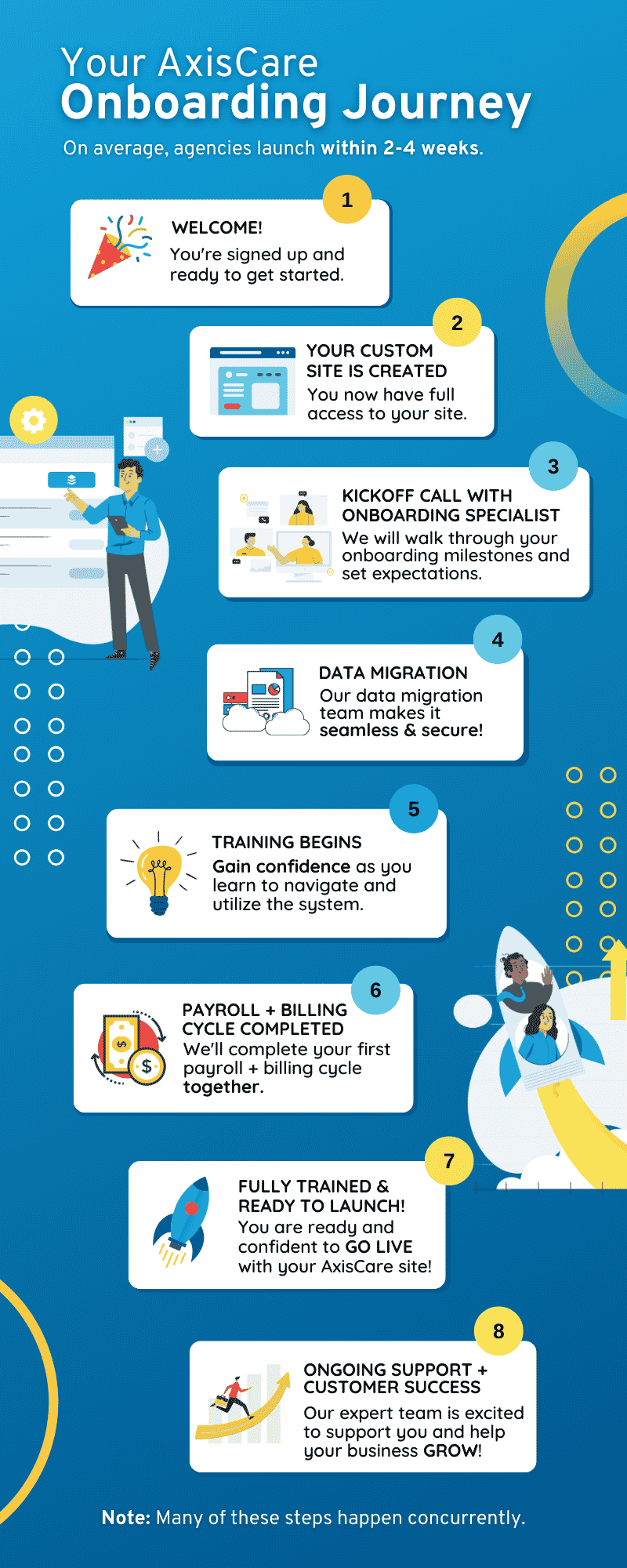
The best move is to choose a solution that treats you as a partner, both in the present moment and with an eye towards the future. Technical setup is one thing — but what about everything that comes after? Your vendor should support staff training efforts and provide the proper resources to smooth the workflow adoption process. Post-launch, keep an eye on how issues are escalated and resolved. The right partner will handle these cases with just as much care and attention as a prospect they’re trying to win over.
How AxisCare Supports Connected RCM Workflows
AxisCare helps agencies improve revenue cycle management with an all-in one home care solution. It unites EHR, billing, compliance, and reporting under a single digital roof, connecting the dots between essential functions for clean claims — and healthy cash flows — every time.
Scheduling is one of the most time-intensive functions for home care teams, and our platform automates it from end to end. Caregivers are intelligently matched to open appointments based on availability, skills, and client preferences, minimizing unassigned shifts and quickly booking slots that open up due to call-outs. And the more shifts you fill, the more shifts you bill.
Since RCM depends on clean, connected data that’s shared across scheduling, documentation, and billing, AxisCare’s unified platform is designed to eliminate gaps where revenue cycle breakdowns typically occur. Automated claim generation pulls directly from completed visit documentation, and built-in EVV captures appointment data in real time.
Connect Billing & Operations in One Platform Environment
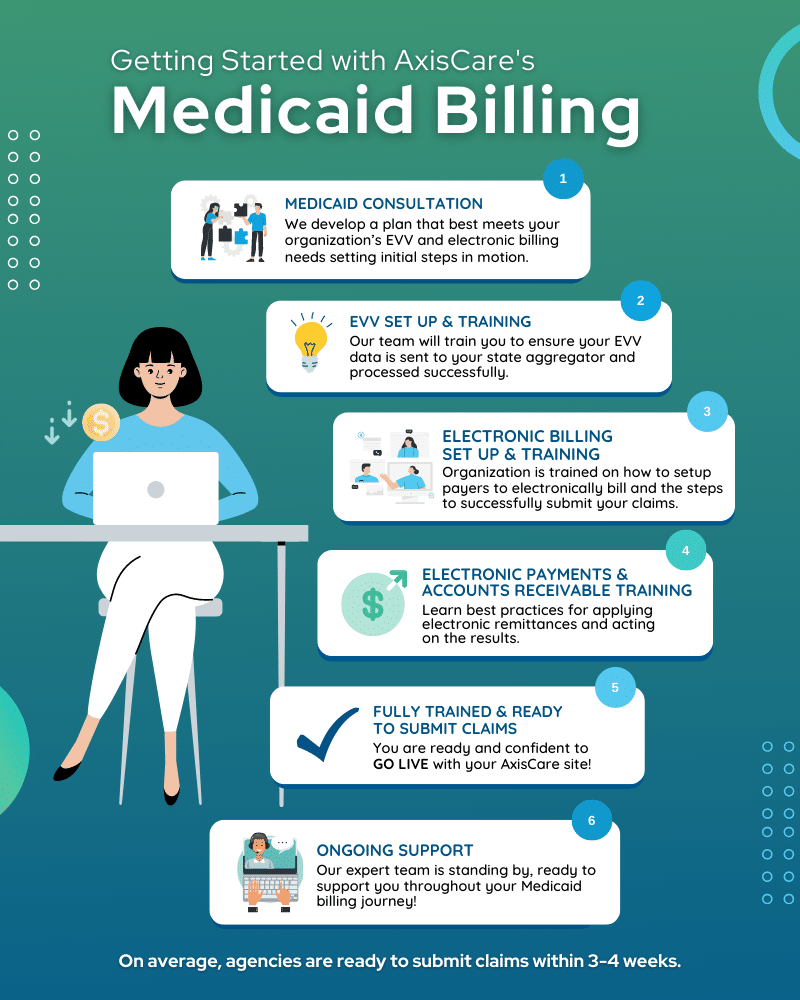
AxisCare allows admins to create, submit, and track claims across multiple payer types and jurisdictions. We offer integrations that support Medicaid, Medicare, the VA, and private insurance, with built-in compliance tools that eliminate the need for manual verification.
Caregivers clock in and out of each visit using our mobile app, capturing visit data in real time and sending it straight to the state’s EVV aggregator. This information then feeds directly into the software’s billing function, creating claims based on clean and verified data.
Support Growth With Interoperability & Enterprise Readiness
Larger organizations that use multiple tools across departments need a platform that connects them all, while supporting role-based access across teams. Finance and operations have very different needs than the clinical and IT departments, and their dashboards shouldn’t be bogged down by documentation that doesn’t concern them.
At the top of the pyramid, leadership needs a bird’s eye view of revenue patterns across locations. Unified reporting is therefore a must, dissolving silos among high-level management to keep financial priorities aligned. Long-term, enterprise agencies will be well-served by scalable cloud-based systems that can easily handle volume growth and provide plenty of integration support.
Scale Growth With AxisCare
Disconnected systems lie at the heart of documentation errors, billing delays, claim denials, and administrative drag. Over time, these issues compound to erode an agency’s financial health and create cash flow bottlenecks. Clean and compliant billing cycles begin with proper RCM integration, built on connected flows that automatically “hand off” data between departments.
Enterprise home care software reduces the friction that keeps departments from collaborating effectively, creating a unified operational foundation that supports consistent reimbursement. Request a free demo to learn more about how we can support your revenue cycle by creating a digital home care hub.
FAQs
An RCM integration must support interoperability with an agency’s entire tech stack, meet compliance and safety standards like HIPAA and payer-specific regulations, enable billing data readiness, and map data from one function to another to create clean claims.
When client information is captured and stored correctly via EHR, it flows through every subsequent step without needing to be fixed or re-entered. Clean data makes it easy to verify client eligibility, cross-reference authorizations, and prove medical necessity. From there, bills can be created based on proven information, resulting in faster submissions with fewer rejections.
Using standardized “languages” like HL7 and FHIR, home health platforms can speak to each other automatically without the need for manual export or double entry. Administrators don’t need to touch the data at all; it simply flows on its own. Less human intervention means fewer opportunities for errors to slip through, which creates cleaner claims. Billing also does not have to wait on information to be sent over by another team — they simply receive it automatically and can submit a bill from there.
Legacy systems may not offer API support, which limits their ability to integrate with RCM tools. Connecting two systems also doesn’t mean the data will transfer correctly: different field structures or inconsistent coding can quickly lead to errors. Since integrations require ongoing maintenance, clients that don’t receive adequate support from their vendors may find themselves firefighting technical issues that are above their pay grade. And without a change management strategy in place, teams may simply choose to work around the integration instead of learning the ropes, which defeats the entire purpose.